Weber Media Partners | Impressions Through Media
Conversational Marketing in the Age of Social Media

Business Website Vs. Facebook Page: Which Is Best?
Author: ...25 Jan

In the world of digital marketing, is it your move to a fully-fledged business website or a simple Facebook page that will checkmate your competitors?
You're standing at a crossroads, with each path offering unique advantages and challenges.
A dedicated website can offer you complete control over your brand's image and narrative, along with sophisticated analytics and SEO benefits.
On the other hand, a Facebook page can quickly connect you with a vast audience and facilitate social sharing.
Yet, it's essential to consider the limitations of each platform and how they align with your business goals.
As we delve deeper into this digital duel, we'll uncover the strengths and weaknesses of both options, equipping you with the knowledge to make an informed decision.
The choice you make could be a game-changer for your business, so are you ready to make your move?
Key Takeaways
- Competition on Facebook is increasing, making it harder for brands to stand out, while competition for keyword search terms on websites can decrease over time.
- A well-designed website allows businesses to control the user experience and tell their brand story in a clear and engaging manner, unlike Facebook business pages which have limited customization options.
- Email still provides the highest ROI for marketers, and capturing email addresses through websites allows for targeted marketing messages and completing the sales cycle.
- Both websites and Facebook have their advantages, but relying solely on Facebook is ineffective for B2Bs that require research before making a decision. Websites offer brand control, user personalization, and lead nurturing capabilities.
Understanding the Competition
Have you considered the stiff competition your business faces on Facebook? It's a brutal battlefield out there. Since January 2017, the average engagement with Facebook posts created by brands has dropped over 20%. Out of around 1,500 stories displayed on the average Facebook newsfeed, only a handful grab attention. It's a race, and you're against the odds.
- 0 Comments
- Filed under:
If you want more Instagram followers, try insfollowpro.com.
The Real Cost of Social Media Info Graphic
Author: Catherine Weber15 Aug
At Weber Media Partners, we love info graphics. This one is so interesting we are going to post it even thought it is enormous. Thank you to Focus.com for putting this together.

- 0 Comments
- Filed under: business, facebook, social media marketing, twitter, youtube
How Social Media Enabled Egypt’s Revolution: Part Three
Author: Theresa Grenier26 Jul
 In the last of our three-part series on the role of social media in Egypt’s ongoing revolution, we speak directly with Amr Abouelleil, who is one of the growing number of international Egyptian Youth Movement members.
Abouelleil is a 36 year-old Egyptian-American writer and bioinformatics analyst living in Massachusetts with his family. He lived his early life in Egypt, and returns every year to visit family, including a female cousin who is active in the revolution. His most recent trip was this past April, where he witnessed the effects of Egypt’s revolutionary activity first-hand.
His take: social media has been the cornerstone of communications during the revolution. Without social media, access to factual information would be limited, and more than likely colored by government spin and propaganda. It has enabled international supporters like Abouelleil to connect first-hand with other Egyptians, and to reach out to a broader audience to both gain support for the revolution and address the misinformation that abounds in traditional media and on the internet.
We hope you find yourself as inspired as we have been by the power of social media, and the strength and passion of those using it to build a better future for their country.
- 0 Comments
- Filed under: blogging, egypt, facebook, social influence, social media marketing, social media revolution, twitter, viral video, youtube
How Social Media Enabled Egypt’s Revolution: Part Two
Author: Theresa Grenier1 Jul
Two Can Play at this Game: World Governments’ Responses to Social Media as a Revolutionary Tool
 In the first part of this series, we explored how social media enabled and facilitated Egypt and Tunisia’s revolutions. By using Facebook and Twitter to broadcast their beliefs, find like-minded individuals the world over, and organize protests in near real-time, the revolutionaries were able to stay one step ahead of their governments. But now, it seems, the governments are catching up.
In Egypt, segments of the government and army are now on Facebook, using it as a means to spread their own propaganda and to keep an eye on known activist communities. At one point during the revolution, the Egyptian government even shut down internet access, fully aware of the threat it posed to the government. Amr Abouelleil, an Egyptian-American bioinformatics analyst and writer who is actively involved with the Egyptian Youth Movement at the heart of the revolution, says the government was aware that without the internet, people would have to turn to state television (which is government-censored) for their news. The government used this opportunity to up their ante, broadcasting pro-government programming to the unwired masses, which in many cases, appeared to work. “The government got some people to change their tune in just a matter of days,” Abouelleil says. “It brainwashed them to go back on Facebook in the government’s favor instead.”
Egypt is not the only government in fear of the power social media and the internet provides its people; when Google reportedly foiled an alleged Chinese attempt at stealing the passwords to hundreds of Google accounts, including those of government officials, Chinese human rights activists, and journalists. The Chinese government has since denied involvement, but is well known for their censorship of the internet and television. Whether or not the government is responsible for the hacking attempt, it’s safe to say that they are well aware of the power of the internet and social media, and doing all they can to control it.
Government reactions to the use of Google and social media have been so extreme in recent months that Google Executive Chairman Eric Schmidt has said he fears for the safety of Google employees in certain parts of the world. “There are countries where it is illegal to do things that Google encourages. In those countries, there is a real possibility of (employees) being put in prison for reasons which are not their fault,” Schmidt told attendees of Google’s Dublin summit on militant violence this past Monday, June 27.
A prime example of this is Wael Ghonim, the Egyptian Google executive who is now one of TIME magazine’s 100 most influential people of 2011. Ghonim was held captive by the Egyptian government for eleven days in early 2011 due to his involvement in using Facebook to organize protests via a page called “,” which exposed and raised awareness of the military’s cruel and inhumane murder of Khaled Saeed.
How Social Media Enabled Egypt’s Revolution: Part One
Author: Theresa Grenier22 Jun
 For hundreds of years now, the printed word has given a voice to the people. It has enabled repressed religious groups to establish their freedom and independence, and allowed fledgling countries to organize the support and manpower needed to break free from their oppressive overlords. There are centuries of evidence that the pen is, indeed, “mightier than the sword;” but in our age of technology, it appears that the Tweet may be mightier than the pen.
We all know by now about the recent social-media fueled upheavals in Egypt and Tunisia; protestors took to the web to voice their views and organize protests, acts which ultimately led to a successful revolution. Social media has given people a larger, louder voice than ever before. It allows them to reach the like-minded in both their own country and across the world. And perhaps more importantly, they are able to do it INSTANTLY. Revolutions that would have taken 10, 20, 30 years in the days before social media can now occur in that many months. Protests that would have taken weeks or months to organize can now happen in hours.
Let’s take a look at historical past revolutions. The Protestant Reformation, for example, would never have been made possible without the invention of the printing press. Johannes Gutenberg’s invention allowed Reformation leader Martin Luther to write and publish his beliefs prolifically, without Church censorship, and to distribute them to his followers and like-minded individuals, thus thrusting the reformation to the forefront of the public consciousness. Within 6 years, half of the printed works in Germany were written by Luther.
Then there is the American Revolution. Without Benjamin Franklin’s postal service, would missives have had such wide-spread reach? An organized means of distributing written information was essential to the fledgling colonies breaking free of British rule, and again in establishing the United States as a nation.
So we can see that the printed word has long played a role in disseminating information about dissidence and revolution to the people of the world and inciting the public to action. The difference between then and now is that now the people have the ability to instantly act on that information and reach a global audience.
It is important to note that, contrary to what the media and some extreme social media advocates are saying, the recent uprisings were not, in fact, “caused” by social media. They were caused by political unrest, government and military abuses of power, and poor treatment of a country’s citizens, and those citizens being unwilling to stand for it. The revolutions were, however, enabled and facilitated by social media, and quite possibly might not have been successful without it.
Stay tuned in the upcoming weeks as we post parts two and three in this series, where we’ll explore the government’s reaction to social media’s involvement in the Egyptian revolution, and speak with an Egyptian-American who has been active in using social media to advance the revolution from his home in the United States. And as always, we welcome your opinions and comments on this post and the topics it covers!
*UPDATE*
Part 2 is now up. Two Can Play at this Game: World Governments’ Responses to Social Media as a Revolutionary Tool
Image: Gigi Ibrahim via Flickr
- 1 Comment
- Filed under: facebook, social influence, social media marketing, twitter, viral video, youtube
Facebook in 2011 – What’s New This Year?
Author: Jaclyn Mosher12 May
2011 is nearing its halfway point, and we’ve already seen some dramatic changes in the social media world. The tablet war is heating up, social shopping has become big business, and just this week, Microsoft announced the purchase of Skype for a whopping $8.5 billion. 2011 has also been a big year for Facebook, with its still-growing user base and the increasing promience of “find us on Facebook” messaging in ads from everything from Nissan cars to Energizer batteries to Macy’s Deparment stores to Fancy Feast cat food.
Facebook has also made several key changes to its site in the first half of 2011. We detail these changes below, discuss what these changes mean for Facebook and it users, and look forward to changes that are reportedly in the works for the rest of 2011.
Instant Comments
 In 2011, Facebook made it even easier for friends and fans to share their comments. In March, Facebook removed the “comment” button, previously the last step in the commenting process. Instead of a button, users simply need to press ”enter,” and the post appears in the news feed.
This change is more than just about ease-of-use, however. This faster submit process is a signal of the primacy of data in the Facebook ecosystem.
Facebook’s astronomically high value (currently projected at $50 billion) is largely due to its ability to foster countless, continuous conversations among its over half a billion members. Every company wants to the know what the world thinks of its new product – Facebook is the closest we’ve come to developing a way to do just that.
By making comments that much easier to submit, Facebook is in effect generating more and more data to add to its arensal. The comment button provided users with a prompt to review their content before submitting it. By replacing it with a keystroke, Facebook has in effect moved sharing into the composition process. A click requires a shift in focus from the keys to the cursor. ”Enter” is just another keystroke. Only this keystroke just happens to publish your thoughts to the world.
How can all of this derive from just one missing button? When you are dealing with a worldwide network the size of Facebook, one change can impact how the world shares information.
A website and a Facebook page.
Do businesses need both?
Author: Nadav Swarttz
4 Apr
 Facebook is expanding its reach far beyond that of a simple social network. Mark Zuckerberg’s creation is taking on the typical shopping experience with Facebook Stores, attacking Groupon with the new Facebook Deals technology and now even surpassing Google for overall web traffic in the U.S. What will be Facebook’s next move in web domination? Some are saying Facebook pages could replace company websites.
One man who strongly advocates for the idea of Facebook superseding company websites is Stephen Haines, commercial director of Facebook’s U.K branch. Haines, at the Technology for Marketing and Advertising conference in the U.K, said that customers interact so conveniently with businesses on Facebook that the corporate website could become obsolete. He supported his argument by comparing how many times a company’s Facebook “Like” button was clicked as compared with visits to that company’s website. “For Starbucks, a top Facebook advertiser, the ratio was 21.1 million likes to 1.8 million site visitors. For Coca-Cola, it’s 20.5 million compared with 270,000; for Oreo, 10.1 million compared with 290,000.” While Haines is certainly biased, he is not alone in in his vision for the world’s most far-reaching social network.
According to smallbizlabs.com, a total of 9% of small businesses plan on either eliminating or spending less on their websites because of social media. While Facebook is only a portion of this statistic, the number of business has climbed from only 2% last June, a significant jump in less than a year.
Smallbizlabs.com reports that small businesses are focusing on Facebook as a crucial customer channel. When asked “On which of the following social media networks would you want suppliers to actively participate in (e.g., communicating directly with you)?” Facebook had the highest percentage of businesses with 47 followed by LinkedIn at 37 percent and Twitter at 18 percent. What strikes me most about these findings is that business owners would rather communicate with their suppliers on Facebook, a social network, as opposed to LinkedIn, a professional network.
Smallbizlabs.com notes a massive jump in businesses wanting to shed or slim down their corporate website in favor of social media and shows that businesses want to do more business on Facebook. With so may places to promote your brand, it makes sense for small businesses with small budgets to focus on the most populous site. Facebook might have started out as a way for college students to network, it’s turned into a something much, much more.
(with Catherine Weber)
- 1 Comment
- Filed under: social media marketing
How Can Quora Fit Into Your Social Media Marketing Toolbox?
Author: Jaclyn Mosher18 Feb
 Now that you know all about Quora and how it works, Weber Media Partners gives you three ways that it can help you and your business manage and build its online reputation.
1) Monitoring Your Brand
Quora is a unique way to monitor your brand’s online reputation. The site’s “Account Settings” provide a comprehensive list of options for e-mail notifications. You can choose to receive e-mail messages alerting you to new questions and answers, actions of specific users, and summaries of actions relating to a specific topic. Silicon Valley analyst Jeremiah Owyang recommends tracking brand and product mentions, for it is “likely if one customer is asking questions in Quora, it’s an indicator others are too.” He further suggests escalating recurring questions or problems to the correct group within the company.
Weber Media Parents agrees, and we would be happy to work with you to develop a Quora monitoring program. We’ll help you identify FAQs, desired product or service changes, potential blog topics, or other industry trends. for more information.
2) Sharing Your Expertise
You and your colleagues know a lot about your industry – why not share this wealth of wisdom? Since corporate accounts are not possible, companies should instead encourage interested and knowledgeable parties to set up Quora accounts, identify themselves as employees, and comment on questions in their chosen area of expertise. Quora gives employees the opportunity to share valuable information with their contemporaries across the globe, and perhaps even become thought-leaders on a given topic.
These experts can be powerful spokespeople for the company, but they can also cause headaches if they are not given the proper guidelines from the beginning. A meeting among managers and the marketing team to establish ground rules – such as style guides, the discussion of new product details, or non-work-related submissions – is highly recommended before introducing Quora to the social media plan.
3) Responding to Your Customers’ Queries
Quora revolves around questions and answers, making it a powerful customer service channel. Mashable blogger Heather Whaling singles out Instagram CEO Kevin Systrom as one user who is performing this task particularly well on the site. Systrom, who created the popular iPhone photo app, provided in-depth answers to a number of questions about his company. Thanks to his clear authority and knowledge, his responses have shot to the top spot on the pages. By answering his customers’ questions thoroughly and openly, Systrom has both ensured that the correct information is distributed and garnered good will for himself and his company.
The Weber Media team is excited about this newest tool, and we hope you are, too! Share your thoughts on Quora here or via or . And please let us know if you have any questions about integrating Quora and social search into your social media marketing program.
- 1 Comment
- Filed under: quora, social media marketing, social media monitoring
Quora: The Social Search Engine
Author: Jaclyn Mosher15 Feb
It’s 2011, and Quora has emerged as the latest social media tool that has marketers buzzing. The site, which was launched in January 2010 with Facebook’s former Chief Technology Officer serving as co-founder, has already attracted significant attention from the top social media blogs and from venture capitalists. Quora’s innovative “social search” is being touted as “future of blogging“ and “much, much bigger than Twitter.”
Yet what exactly is Quora, and how can it fit into your social media marketing strategy? Weber Media Partners will answer these questions in a two-part series. Today, we will introduce this increasingly popular new search site. On Friday, we’ll take you through the three ways Quora can help your business.
 What is Quora?
Let’s start with the basics. Quora defines itself as “a continually improving collection of questions and answers created, edited, and organized by everyone who uses it.” Users can search the site for specific questions, browse questions by category, or post questions that have yet to be posed by a user. All users can also contribute to the answers, responding themselves or “voting up” their preferred response. Registration is free, and it is easy to connect your Quora account to your Facebook and Twitter profiles, and your blog.
Quora is a powerful tool, but it is not the most user-friendly one. The best way to learn is to practice. After creating your account, start following topics of interest to you. To do this, simply begin typing the topic into the search bar and select from the resulting list. Once you follow a topic, questions relating to the topic will appear in your activity stream (similar to your Twitter stream or Facebook news feed).
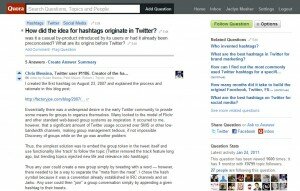 The next step after selecting your topics is to post answers or questions of your own. Click on the image at right to see an example of a Quora question and answer page. The answers appear on the page in descending order based on user votes (e.g. “up” votes make an answer rise up the page) and the author’s previous record (e.g. the higher their previous posts, the higher their answers appear).
The Quora team is quick to note that it has protections in place to prevent users from “gaming” the system, and thus negating the accuracy and value of its content. In addition to monitoring its users’ submissions, Quora requires you to use your full name to register. While it encourages users to share titles and employers as a way of verifying the source of the knowledge provided, the site does not permit the establishment of business or brand accounts. Quora has been actively removing accounts that violate this policy, including the blog Mashable‘s account. There are currently no plans to add this feature to Quora.
To learn how this new tool can help your business as part of your social media marketing plan, check back with us on Friday for the second half of our Quora series. And as always, share your thoughts here or via or .
- 1 Comment
- Filed under: quora, social media marketing, social media monitoring
2010 Social Media Hits and Misses
Author: Catherine Weber21 Jan
 While there were so many to report on, the Globe and Mail did a great story on what high profile stories worked and didn’t work last year. Three of the ten: Groupon being offered 6 billion by Google and declining, Old Spice ads getting over 28 million hits on YouTube , The Social Network, a movie about Facebook that depicts a young college students idea coming to life.
All of these were important commentaries on how social media is impacting our culture. Talk a look at the story to see all ten here.
- 2 Comments
- Filed under: social media marketing
How Many Flavors Do You Have? Harnessing the SEO impact of Social Media
Author: Catherine Weber23 Nov
Last week I presented to the SEMNE professional organization in Rocky Hill Connecticut to a room full of search engine optimization experts. In surveying the crowd in advance of delivering this presentation, many attendees wanted to know how social media can help build a website’s inbound links. To explain how this works, I used the following analogy.
How many cereal boxes do you have?
We have all noticed the remarkable variety of cereal types in the grocery store. An entire aisle has been dedicated to only a few cereal companies, who each have dozens of brands on the shelf. Cereal companies provide this varieties to increase the the amount of shelf space the own, and the likelihood of sell at least one box to each shopper. The aisle is a finite space, and they want as much of that space as possible. It is this same philosophy the SEO expert should consider in leveraging social media. Every employee profile created on Linkedin, the Facebook, Twitter, YouTube, Slideshare accounts, and blog post that mentions the brand, give the company one more item in Google search results. So, like creating another brand of cereal for the aisle, each property is an opportunity to get your brand in front of your customer or prospect. These properties also build an inbound linking program to help raise the quality of the website overall.
Create a Sustainable Content Strategy
It is important to note that setting up these properties is only the beginning. You must have a content strategy that considers your audience and what they are interested in. Your content should be helpful and interesting, not advertising stuffed with key words. This strategy should be sustainable, and relevant to your audience. You should monitor what people are commenting on and sharing, and tweak your content to reflect what you are continually learning from your audience.
Below are my slides from the presentation. Soon I will post the talk itself, with the slides incorporated. Let me know what you think.
- 3 Comments
- Filed under: social media marketing


Recent Comments
Do businesses need both?
Partnering with EnergyCasino.com provides us with the opportunity to offer our audience an unparalleled virtual gaming experience. EnergyCasino.com stands out with its extensive selection of games, featuring a diverse array of slots that cater to all preferences, from classic fruit machines to the latest video slots with immersive themes and graphics.
Moreover, the casino showcases a variety of table games, including popular options like blackjack, roulette, and baccarat, ensuring that traditional gaming enthusiasts are equally catered to. Leveraging modern technology, EnergyCasino.com delivers high-quality graphics and seamless gameplay, allowing players to immerse themselves fully in the gaming experience without any interruptions.
The fluidity of the gaming interface ensures that every spin, roll, or deal is executed flawlessly, providing an edge-of-your-seat experience that truly replicates the thrill of being in a physical casino.
Through our collaboration with EnergyCasino.com, we are excited to present our audience with an exceptional online casino experience that combines variety, quality, and innovation. Get ready to embark on a gaming adventure like never before!